
Why customer retention is increasingly the retailer’s responsibility
by Glenn Mercer
In this guest piece, independent automotive researcher and industry veteran Glenn Mercer—who recently delivered a keynote address at this year's Autotrader Road Ahead conference—explores why customer retention must become a primary focus for today's retailers. For a full recap of Glenn's presentation and the day's other strategic takeaways, be sure to read our Executive Summary published last week: The Road Ahead 2026: From Ideas to Action
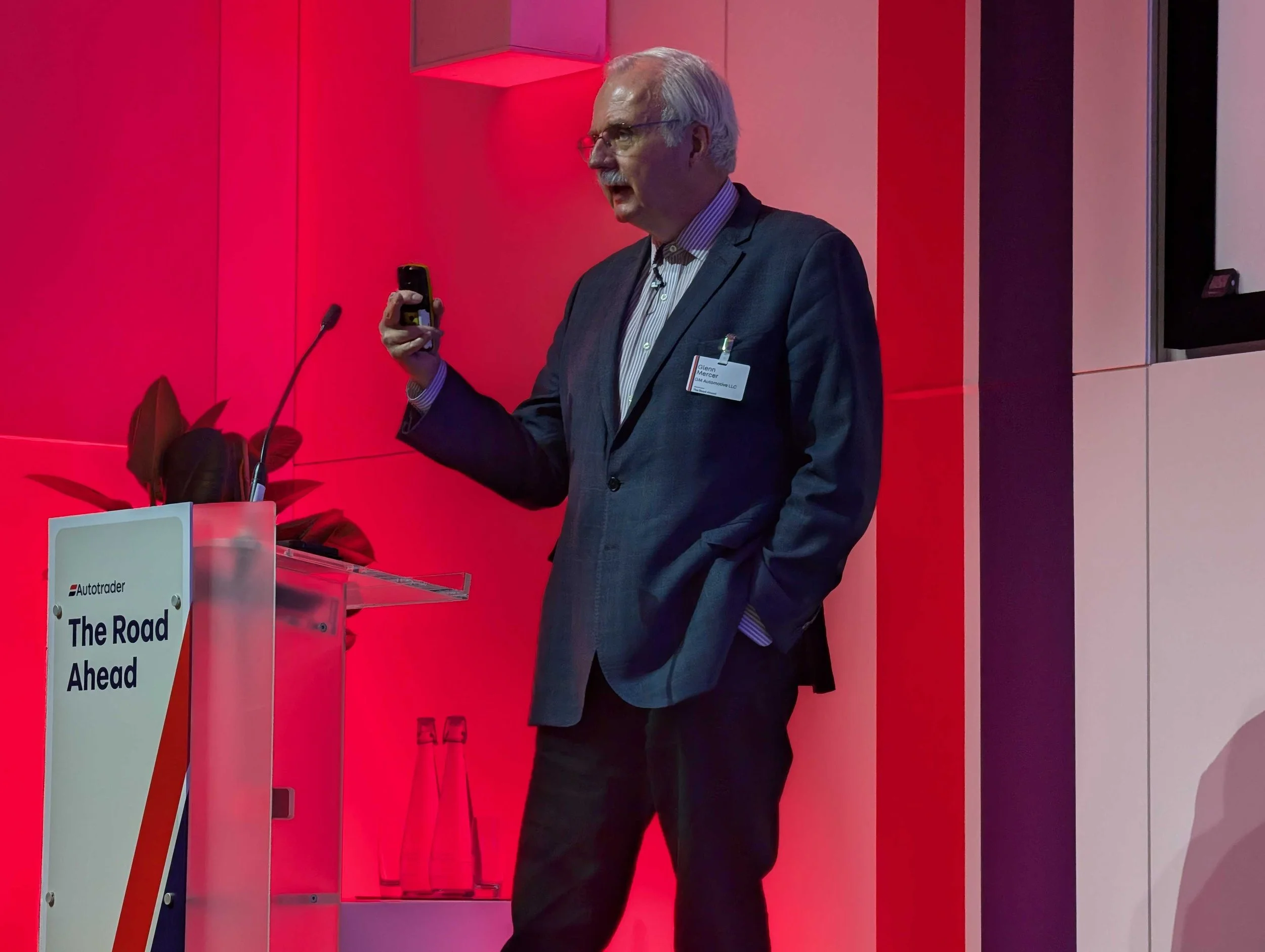
Glenn Mercer addresses the audience at this year’s Road Ahead conference.
For decades, customer loyalty (the emotional tie between a customer and a car brand or retailer) has been one of the automotive industry’s preoccupations, for very good reasons: among other benefits, it is much less costly to sell to a loyal customer than to keep conquesting new buyers. And keeping customers coming back to the brand and to the store has never been more challenging, as we shall see below.
But before we dive in, let’s step back and make a key distinction: what really matters, commercially, is not loyalty but retention. A loyal customer may love car brand Acme, but if the customer needs a crossover and Acme sells only saloons, Acme will not retain the customer. And a loyal customer may adore Fred’s Acme store for its quality maintenance and repair, but if the customer works a late shift and Fred’s closes at 6pm, Fred will not retain that owner’s aftersales business. So, let’s focus hereinafter on retention, which rings the cash register, rather than loyalty, which may give us all a warm feeling, but does not necessarily translate into financial success.
The industry’s retention journey
Efforts to improve customer retention have evolved alongside the automotive industry itself. In its earliest years, there was effectively no concept of retention at all. When the Ford Model T arrived, the message to customers was simple: buy the car – and fix it yourself. (In fact, Henry Ford himself said the car was designed with farmers in mind, who often had the tools and mechanical skills needed to repair them on site.)
Over time, however, the industry began building mechanisms to maintain links with customers between purchases, especially as competition multiplied and shoppers had so many more options. Arguably the first retention tool was the car loan (thank you, General Motors!), which not only enabled cash-strapped drivers to get behind the wheel but tied them to the OEM through monthly payments. Decades later, warranties were extended beyond a mere 30 days to many years and miles, providing valuable aftersales revenue to dealers and further tying the customer to the brand and the store.
But in the 1960s and beyond the independent aftermarket began to consolidate and professionalise, with the rise of national chains such as Jiffy Lube in the USA and Kwik Fit in the UK, and car OEMs and their retail partners found themselves losing ground in aftersales revenue and profit. In the USA, for example, franchised dealers’ share of aftersales revenue fell from about 45% in 1965 to about 30% today (though the decline seems to have stabilized somewhat in recent years).
The UK’s loyalty / retention problem
All markets face retention challenges, but the UK currently presents a particularly interesting case. Data from the Deloitte Global Automotive Consumer Study suggests UK buyers show the lowest levels of loyalty to manufacturer brands among major developed markets.
This was to me a surprising finding, as the UK felt like a market where generational brand loyalty – ‘my father drove a Ford, my grandfather drove a Ford’ – would still have great influence. Yet the available evidence suggests those ties have weakened dramatically, and lower loyalty does at some point feed into lower retention.
The reasons are not entirely clear to this US-based observer, but several factors are likely contributing:
The UK market has an unusually large number of brands (over 70, according to Auto Trader) competing for attention, many of them recent arrivals.
Incumbent UK brands have in some ways retreated over time, through bankruptcies, plant closures, mergers, and downsizing (including trimming of product lines)
The UK electrification push (or pull, depending on your perspective) seems to have loosened the ties of loyalty, since often it is a new firm that provides the best EV products.
And the financing structures that dominate the UK market, such as PCP, leasing, salary sacrifice, Motability, et cetera, create more distance between the driver and the supplying retailer, by entrenching a separate financing intermediary. These programmes offer flexibility and accessibility, but they also weaken the traditional ties between customer and store.
The net effect is the manufacturer brand no longer performs as much of the retention work as it once did. The follow-on implication is that the retailer must shoulder more of the burden now: if local drivers are no longer in love with Acme, Fred has to make sure they still love him.
Retaining the new-car customer
When it comes to new-car retention (bringing the customer back again and again for each new purchase), the natural strategy for retailers to consider is to multi-brand. Large groups such as Penske Automotive and Lithia Motors have built extensive portfolios of brands so that customers can remain within the same retail network even if they change marque. That is a difficult strategy for smaller single-site retailers to fully replicate, but of course even a small store can often add at least a second brand, as we see traditional retailers in the UK adding second “challenger” new brands to their facilities.
Why aftersales is the critical battleground
But it is in aftersales where retention really matters, for various reasons. Obviously, aftersales retention is incredibly valuable in and of itself, as maintenance and repair are the largest drivers of retailer profit in most cases. But as is well known in the industry, satisfaction with service turns into satisfaction with product: a retailer is much more likely to sell a new car to a customer who has been delighted with years of good aftersales work, than otherwise.
This only makes sense: the initial purchase transaction may last a few hours, but that took place five years ago, while service visits happen repeatedly throughout the life of the vehicle. Those interactions shape the customer’s perception of the retailer far more than does the original sale.
Even if when the public and the press talk about “dealers” they almost always default to the new-car purchase experience, which is only a small part of their total exposure to the car retailing ecosystem. (This focus reminds me of travellers who evaluate the quality of an airplane pilot by how well she or he managed to ‘stick the landing’, which can at most represent 1% of the entire flight time.)
Research consistently shows that satisfaction with servicing is the strongest predictor of whether a customer will buy their next vehicle from the same retailer.
In sum, therefore, retention in the service department is not just a generator of profits today, it is a generator of profits tomorrow.
The one factor that matters most
All the preceding is blindingly obvious: the industry is aware of both the importance of retention, and the pressure it is under. So, to move from diagnosis to prescription, what do we do about this?
I do not want to come across as arrogant: with thousands of retailers active in the UK, for well over one hundred years now, it is beyond exceedingly unlikely that there is some sort of ‘retention silver bullet’ which would, once installed in your store, transform transitory customers into dedicated and perpetual repeat buyers.
But we can survey the various stratagems and tactics some of the more successful retailers (in the US and in the UK) have applied, and review them with dealers, to see if one or more of these would deserve a second look, or increased emphasis, in their stores.
And there is one consistent theme across these stratagems, beyond the absolute ground conditions – easy to say but not so easy to execute – of having the right people with the right training reliably executing the right processes! This is, in a word, CONVENIENCE.
Our industry often emphasises trust, transparency, consistent communication, et cetra. Of course, those things are important, but they are largely table stakes, and in my experience drive stated responses by customers. By “stated” I mean this is what customers say they want.
What drives derived response is convenience. By “derived” I am using marketing-speak about what customers actually do. Thus, the gap between stated demand for healthy food and the derived demand for a jumbo bag of crisps! The one factor that consistently influences actual customer behaviour across all demographics – young, old, singles, families, rich, poor – is convenience.
Customers increasingly choose service providers that minimise disruption to their daily lives. That might mean extended service hours, vehicle collection and delivery, mobile servicing or satellite service locations. In the United States we have seen customers steadily prioritise convenience over price. 25 years ago, when asked why they visited independent garages rather than franchised retailers, most cited cost. Today convenience ranks higher. That shift is likely to accelerate as consumers place greater value on their time.
A more competitive future
Manufacturer brands can no longer be relied upon to maintain a loyal phalanx of customers. Retailers cannot replace all of that loyalty (and of course loyalty is only ebbing, not disappearing), but it is clear they must do more of the heavy lifting regarding retention than they have in the past, particularly through the service experience they provide.
In an era of declining brand loyalty, expanding competition, and powertrain shifts, the retailers that make convenience central to their strategy will be the ones most likely to retain their customers – and their profitability – in the years ahead.
Originally published in Auto Sunday prior to Autotrader’s Road Ahead conference.